
Sourdough starter not rising? Causes and fixes
A starter that won't rise is usually too cold, fed too big a ratio, or rising and falling while you aren't looking. Keep it at 75 to 80F, feed it 1:1:1, put a rubber band at the starting level, and check it every couple of hours. New starters also go quiet for a few days in their first week, which is normal.
8 reasons a starter isn't rising
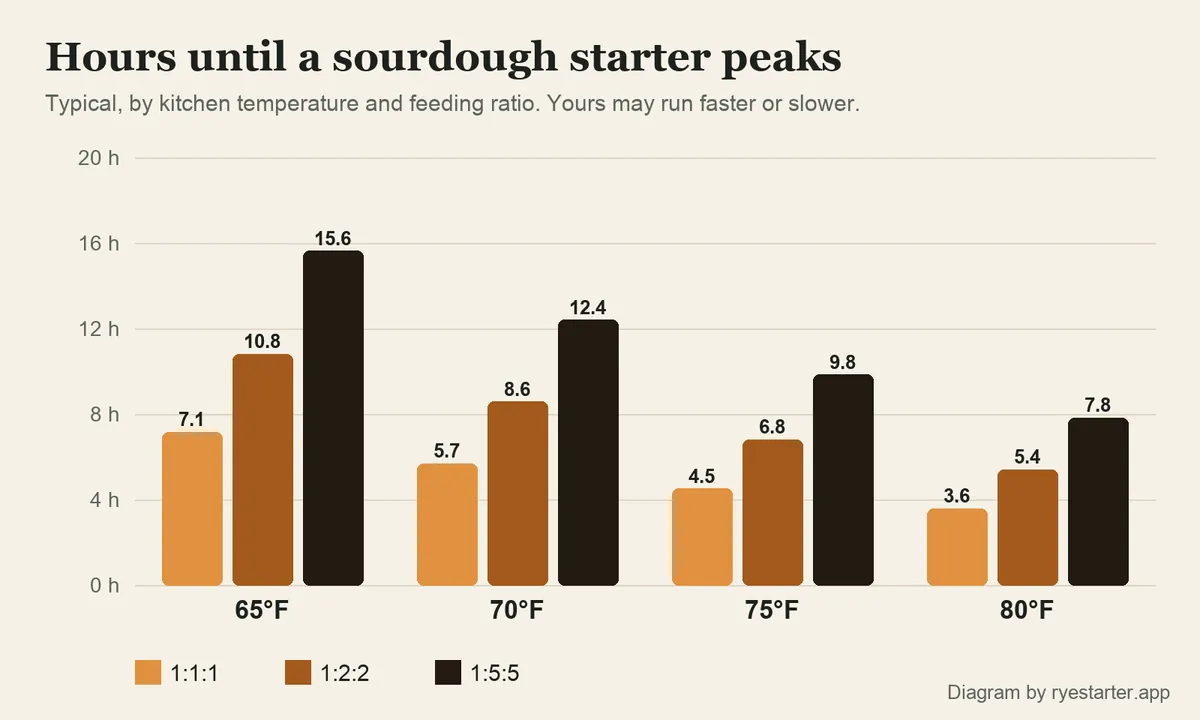
- The kitchen is cold. Below about 70F everything slows down. At 65F a starter can take twice as long as at 75F. Try the oven with only the light on (check it doesn't get hotter than about 80F), the top of the fridge, or near, not on, a warm appliance.
- It already rose and fell. Look for streaks or a dried ring on the jar above the current level. If they're there, it peaked while you were away. Feed it earlier or check sooner.
- The feeding ratio is too big. A 1:5:5 or 1:10:10 feed dilutes the starter a lot and takes many more hours to peak. Go back to 1:1:1 or 1:2:2 until it's lively again.
- It's a new starter in the quiet phase. The early burst on day 2 or 3 is mostly bacteria. Then it can go flat for several days. Keep feeding; the yeast catch up, often in week two.
- It just came out of the fridge. A cold, hungry starter needs two or three feedings at room temperature before it rises on schedule.
- It's very runny. A thin, high-hydration starter lets gas escape, so it bubbles without climbing. Use a little less water and it will rise visibly.
- The flour is weak. Bleached or low-protein flour gives the starter less to work with. Mix in some whole wheat or rye.
- The water is heavily chlorinated. Most tap water is fine, but if nothing else works, try filtered water or tap water left out overnight.
A reset routine that works
Keep 25 to 50 grams of starter and discard the rest. Feed it 1:1:1 by weight, with a quarter of the flour as whole wheat or rye, at 75 to 80F, every 12 hours. Mark the level after each feed. Most sluggish starters double reliably within two to four days. The starter calculator does the feeding math and estimates the peak time.
How long should it take to rise?
The chart above shows typical peak times by temperature and ratio, from our feeding schedule guide. Every starter differs, so time yours a few times and use its real numbers.
Track it instead of guessing
Rye logs each feeding and the temperature, predicts when your starter will peak, and learns from when it actually does. You stop missing the rise, and you can see if it's getting stronger day by day.
Coming soon to the App StoreQuestions
Why is my sourdough starter not rising?
The usual causes are a cold kitchen, a feeding ratio too big for how strong the starter is, a starter that rose and fell while you weren't watching, or a new starter in its quiet phase. Warm it to 75 to 80F, feed 1:1:1, and mark the jar to see what it really does.
How long should it take a starter to double?
A healthy starter fed 1:1:1 at about 75F usually peaks in 4 to 6 hours. At 65F it can take twice as long, and bigger feeds like 1:5:5 take longer still.
Why did my new starter stop rising after a few days?
Very common. The big rise on day 2 or 3 is usually bacteria, not yeast. As the starter turns acidic those bacteria die back and it goes quiet for a few days before the yeast take over. Keep feeding on schedule.
Does whole wheat or rye flour help a starter rise?
Usually yes. Whole grain flours carry more nutrients and wild yeast than white flour. Replacing a quarter to a half of the flour with whole wheat or rye often wakes up a sluggish starter.