
The sourdough float test: how to do it and when to trust it
Drop a spoonful of starter into water: if it floats, it's full of gas and likely ready to bake with. If it sinks, it may not be at its peak yet. The test is a quick guide, not proof: whole wheat, rye and stiff starters often sink even when they're strong.
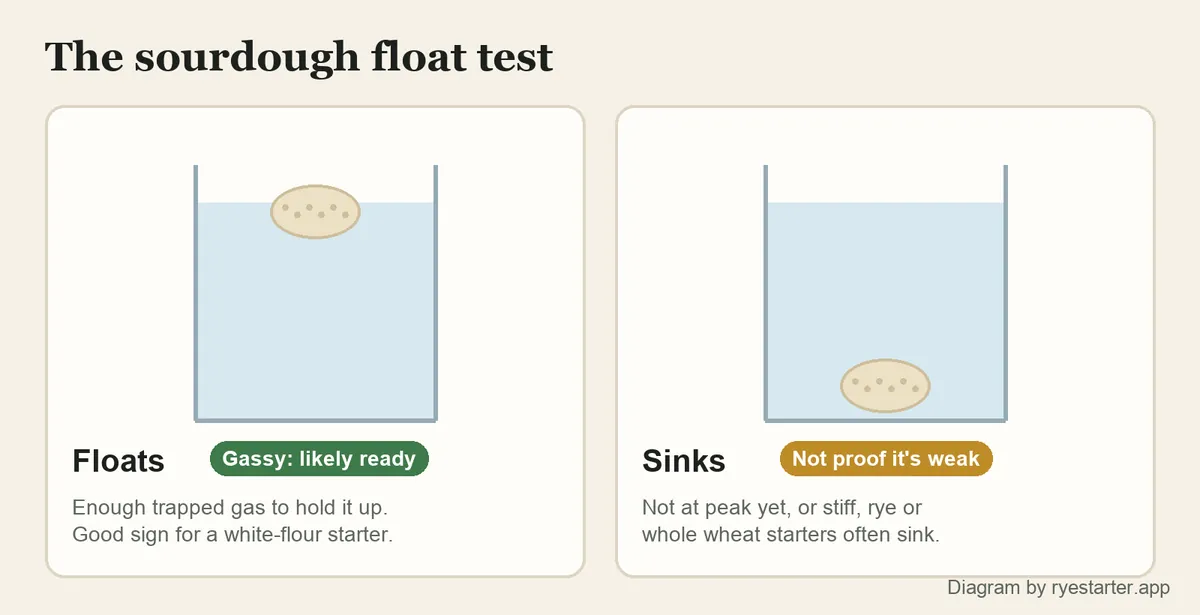
How to do it
- Fill a glass with room-temperature water.
- Without stirring the starter first (stirring knocks out gas), scoop a teaspoon from the top.
- Drop it gently onto the water and watch for a few seconds.
What the result means
| Result | Likely meaning |
|---|---|
| Floats | Enough trapped gas. Bake now, near the peak. |
| Floats, then sinks | Close to ready, or just past peak. |
| Sinks, starter barely rose | Not ready. Give it time somewhere warm. |
| Sinks, starter doubled and domed | Probably fine. Common with whole grain and stiff starters. |
Better signs your starter is ready
- It has at least doubled since feeding. A rubber band at the starting level makes this easy to see.
- The top is domed or just starting to flatten, with bubbles throughout.
- It smells pleasantly sour and yeasty, not like nail polish (that's a hungry starter; see hooch).
- It's near the time it usually peaks. The starter calculator estimates that from your ratio and kitchen temperature.
Track it instead of guessing
Rye predicts when your starter will peak from the feeding and your kitchen temperature, and reminds you, so you use it at its best instead of testing spoonfuls.
Coming soon to the App StoreQuestions
How do you do the sourdough float test?
Drop a small spoonful of starter into a glass of room-temperature water without stirring it first. If it floats, it holds enough gas to raise bread. If it sinks, it may not be at its peak yet.
Is the float test accurate?
It's a rough guide. A white-flour starter at 100% hydration that floats is almost always ready. But whole wheat, rye and stiff starters often sink even at their peak, so a sinking spoonful doesn't prove the starter is weak.
What should I check instead of the float test?
Whether it doubled (or more) since feeding, has a domed top full of bubbles, and smells pleasantly sour. Timing matters most: use it near the peak, when it has stopped climbing but before it falls.
My starter sank. Can I still bake?
If it doubled and is domed and bubbly, yes. If it barely rose, give it more time in a warm spot, or feed it and try again at its next peak.